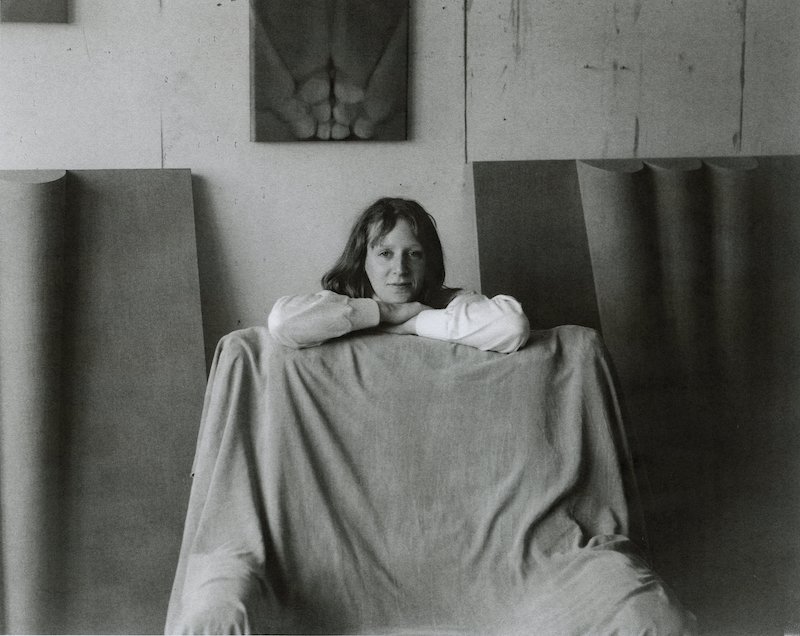
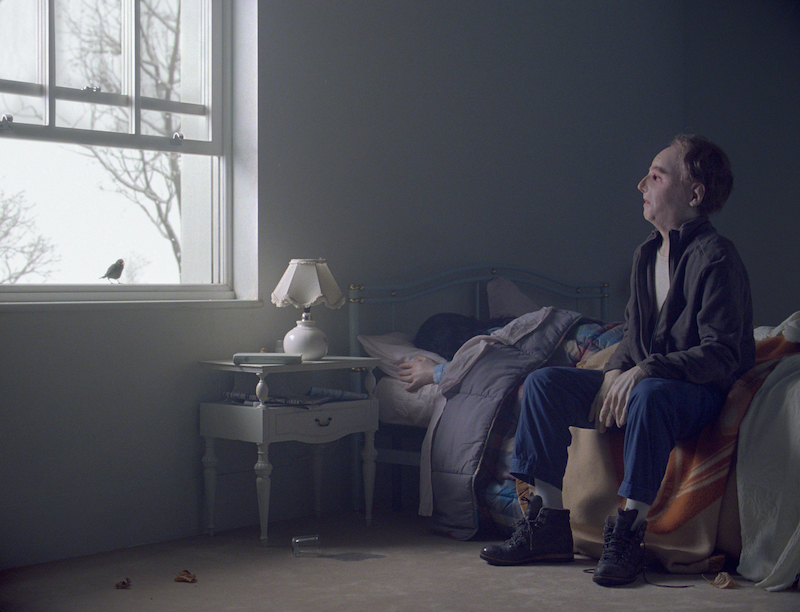
Bogna Burska and Daniel Kotowski's piece “Liquid Tongues” was chosen for the Polish Pavilion at the 61st International Art Exhibition – La Biennale di Venezia (2026). It unfolds over a two-screen video installation. Thirty members of the Chór w Ruchu (Choir in Motion), which consists of hearing and deaf people, perform the libretto both underwater and on the surface, using sound and sign language to move across various forms of communication. Inspired by Roger Payne's legendary 1970 recordings Songs of the Humpback Whale, which led to a ban on whale hunting, “Liquid Tongues” explores possibilities of multi-sensory communication, Deaf Gain, and the importance of giving "voice" to bring about societal transformation. Interview by Lea Schleiffenbaum.
20 July 2026
17 December 2025
INTERVIEW: "PIERCING THROUGH"
Natalia del Mar Kašik, Aufsicht, videostill, 2024
In piercing through, a current group exhibition at DAS WEISSE HAUS developed within the Curators’ Agenda: VIENNA 2025, the curators Trinity Njume-Ebong, Ahmad Darkhabani and João Dias turn their attention to a concept that exerts persistent pressure on artistic lives and institutions alike—success. Working with eight emerging artists selected through an open call at the Academy of Fine Arts Vienna, the curatorial trio examines how success is produced, performed, and contested—across institutions, markets, diasporic trajectories and personal biographies—amid shrinking cultural budgets and a rightward political shift that increasingly pressures the art field. Their exhibition moves between conceptual, performative and materially experimental approaches, addressing how value and recognition circulate today. In conversation with Anna-Lena Werner, the curators discuss their criteria, collective process, and how navigating a residency shaped their thinking about the urgencies of this moment.
20 November 2025
INTERVIEW: BASSAM ISSA AL-SABAH & JENNIFER MEHIGAN
"Uncensored Lilac" (still) HD CGI Film (2024) © Bassam Issa Al-Sabah & Jennifer Mehigan.
In this conversation with artists Bassam Issa Al-Sabah and Jennifer Mehigan, we discuss “Biolytic Daughter”, their collaborative exhibition at VSSL Studio in London (6–30 November 2025), which unfolds within the programme “Entanglements of the Apocalypse”. Emerging from their collaborative film project “Uncensored Lilac,” the exhibition expands their shared world of digital mythology and queer sensuality into sculptural and spatial forms. Our discussion traces the feverish, ironic tenderness at the heart of their collaboration and how they navigate the blurred boundaries between beauty and collapse, digital desire and embodied decay. We also speak about working with Carefuffle––a disability- and queer-led working group rooted in the principles of care, interconnectedness, authorship and social justice––who have been supporting VSSL Studio and the artists in making the exhibition as accessible as possible. This collaboration has opened up new ways of thinking about care and access as integral to artistic production rather than as an afterthought.
“Entanglements of the Apocalypse” is a transdisciplinary programme exploring queer and trans imaginaries of world-building in response to ongoing collapse, co-curated by Mine Kaplangı, Benjamin Sebastian, Joseph Morgan Schofield and Ash McNaughton at VSSL Studio in London. Grounded in research and collective practice, it resists capitalist and colonial framings of apocalypse as an end, instead approaching it as a continuous condition, a site for transformation, intimacy, and speculative renewal.
14 July 2025
INTERVIEW: FLORIAN DOMBOIS
2 June 2025
INTERVIEW: MANOR GRUNEWALD
Manor Grunewald, "Re-Painting Class Studio" 2025, all images © the artist
In the exhibition “Timeline Samples” at Berthold Pott Gallery in Cologne, Belgian artist Manor Grunewald revisits his own painterly archive, reconfiguring earlier works through processes of sampling, reproduction, and self-referencing. By integrating techniques from both amateur painting manuals and digital printing technologies, his practice interrogates the circulation of visual knowledge and the construction of artistic authorship — turning painting into a recursive, self-referencing system. In this conversation, Grunewald reflects on how the studio informs his decisions in exhibition-making, how intuition and iteration shape his process, and how the boundaries between professional and pedagogical image economies begin to dissolve.
7 August 2024
INTERVIEW: EVERY ISLAND
Standing, from left to right: Andrea Mancini, Juliane Seehawer (EI), Caterina Malavolti (EI), Alessandro Cugola (EI)
Seated: Joel Valabrega (MUDAM), Martina Genovesi (EI)
© Alessandro Simonetti, 202331 August 2023
INTERVIEW: ÉLISE LAFONTAINE
Last April, I collaborated with Élise Lafontaine on her exhibition "Dornach Pillars", at Centre Clark in her hometown Montreal, Canada. I was willing to meet up again to take a reflective, perhaps already nostalgic look back at the exhibition. In the course of our discussion, Élise Lafontaine evoked her relationship to painting, from its technique, its history and the representatives that touch her personally, to the very object, in volume, of painting. She spoke about her investigations, proprioception and spatiality, the inner sound of organ pipes, about the architectures that confine her personal memories but also about her almost visceral need to disorientate and to disorientate herself. We took a stroll around the exhibition, through her paintings and current thoughts, and delve into her work, right to the back side of her canvas, or around.
22 July 2023
INTERVIEW: SOPHIE ERLUND
Portrait Sophie Erlund in her studio / photo: Anna-Lena Werner
There is always something unrecognizable – a small moment of disturbance and hesitation – in the work of Sophie Erlund, a Danish born artist living and working in Berlin. Trained as a sculptor during her BA at London’s Central St. Martins College, as well as in Copenhagen and Rhode Island in the US, she dedicates her practice to creating sculptures, installations and soundscapes and to exploring questions about the more-than-human. Starting her career in Berlin with legendary self-organized group exhibitions in her apartment, titled “HOMEWORK”, she has since exhibited internationally in galleries and museums.
It’s early spring 2023 – Sophie and I are now sitting in her studio in Kreuzberg, located inside a large industrial backyard building where lots of artist friends and Sophie’s partner also have their workspaces. Her dog Ayla joins us, we drink strong coffee. We’re surrounded by singular works of hers that were once part of an exhibition she did or currently in preparation for upcoming projects. I am resting my eyes on a wood structure that is placed on a table just next to us and seems to be in progress of becoming something else. Again, I can’t figure it out, but it looks like one of Sophie’s pieces. Both organic and architectural, no recognizable shape and still familiar. I ask her about its history and she shows me a photo of a similar work, once integrated in an exhibition called “Lived synchronicity” at PSM Gallery in Berlin in 2018. That’s how our interview begins.
8 November 2022
INTERVIEW: MYKOLA RIDNYI
“I want to say something about this situation without repeating the violence”, says Mykola Ridnyi – Ukrainian multi-media artist, who dedicated much of his artistic research to the question of how and how not to respond and represent images of conflicts. Carefully, his films, installations and public art works address states and histories of violence – especially the Russian war against Ukraine – through poetic moving images, fictional narratives or non-linear montages. His works were shown in various international exhibitions, such as at La Biennale di Venezia, Pinakothek der Moderne in Munich, daad galerie Berlin, Transmediale in Berlin, ZKM Karlsruhe, Museum for Modern Art in Warsaw and Bonniers Konsthall in Stockholm. In April and May 2022, Mykola and I had two video calls between Berlin and Ukraine, followed by jointly editing the interview according to the situation of his country and his hometown Kharkiv. As opposed to Springtime, when Mykola had to find shelter in Lviv and could not leave the country, he is now able to travel to his exhibitions and currently spends a residency at the Quadriennale di Roma in Italy. In our conversation, we spoke about his theory that relates the science of vision to the perception of war, about how media enforces a voyeuristic addiction to images of violence and about the current situation for Ukrainian artists.
26 September 2022
INTERVIEW: DIEGO MARCON
10 September 2022
INTERVIEW: CORNELIA BALTES
Studio Cornelia Baltes, Photo credit: Cornelia Baltes
5 November 2021
INTERVIEW: INDIA NIELSEN
India Nielsen "guardie e ladri (cops and robbers)" - 2021 - photo © Damian GriffithsIn her paintings, London-based artist India Nielsen interweaves subjective experience with elements of the 1990s and 2000s pop culture. As a teenager, she identified with MTV (Music Television) stars, such as Britney Spears, Madonna and Eminem. At the same time, the visual, ritualistic world of her Catholic upbringing were formative: the saints with their supernatural abilities, seemed to her to reflect aspects of the human psyche split in pieces, the iconography of the Sacred Heart and the Weeping Virgin Mary and the spiritual dimension of Catholicism. India Nielsen sees her paintings as vessels in which her inner life, her memories, feelings and projections can be inscribed and unfold. She studied at the Slade School of Fine Art from 2012 to 2016 and graduated with an MA in Painting from the Royal College of Art in 2018. On the occasion of her London solo presentation “M is for Madonna, M is for Mariah, M is for Mother” at Darren Flook (which also marks the inauguration of his new gallery space, a former psychotherapist’s office on 106 Great Portland St.), we discuss the effects the COVID-19 pandemic had on Nielsen’s practice, her enduring love for pre-eminent pop divas, her fascination with the saints of the Roman Catholic Church and the distinct dichotomies that pervade the artist’s painting practice.